A pilot’s emergency locator transmitter (ELT) may remain silent for years, yet its battery must work immediately after a hard landing. This guide explains how to identify the correct battery, inspect its condition, and arrange a reliable replacement. It focuses on practical checks used by pilots, aircraft owners, and qualified maintenance professionals.
When to replace the batteries in a pilot's emergency locator? The answer depends on the ELT model, battery type, installation date, and manufacturer’s stated replacement interval. Some batteries have a fixed service life, while others require replacement after activation or exposure to impact, heat, or moisture. The date label may sit beneath a small access panel, so use proper lighting and avoid forcing the cover.
Look closely.
A weak battery can show corrosion, leakage, swelling, or damaged terminals. However, a clean exterior does not prove dependable performance. Technicians should verify the unit according to the aircraft and ELT maintenance instructions, using approved test procedures and equipment. Never install a battery solely because its connector appears similar. Polarity, chemistry, capacity, and certification requirements must match exactly.
This guide also considers records, workshop communication, and safe disposal. A replacement entry should include the battery part number, installation date, technician details, and any required inspection results. Real-world maintenance is not always perfectly tidy; labels fade, logbooks contain gaps, and earlier servicing may be unclear. That uncertainty deserves attention, not guesswork. When information conflicts, pause the replacement and consult the ELT manufacturer, aircraft maintenance manual, or an appropriately qualified aviation professional. Reliable emergency equipment depends on small details being handled carefully.
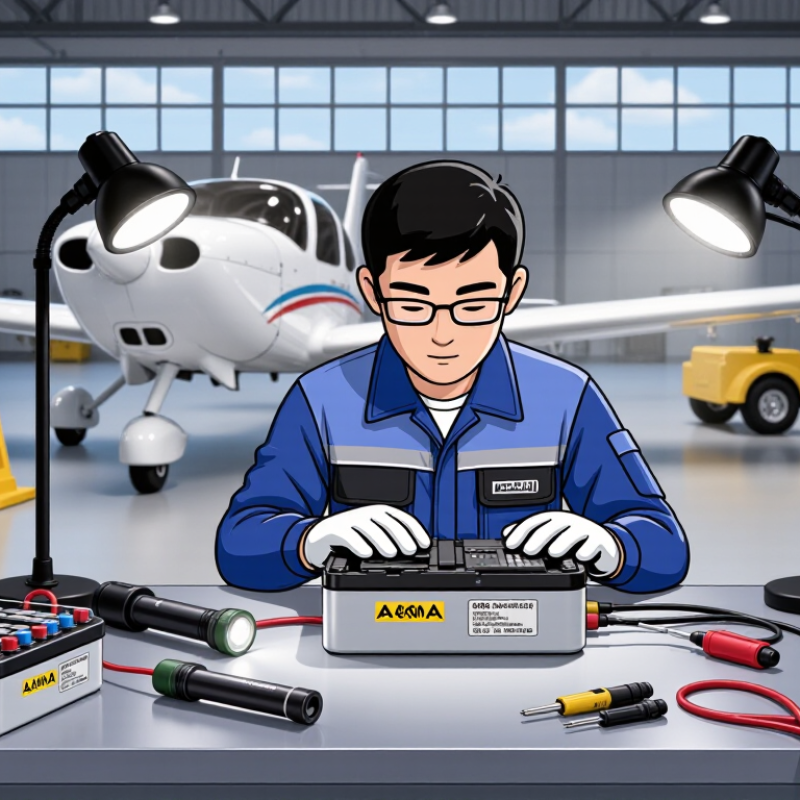
Pilot Emergency Locator Transmitter Battery Types and Replacement Standards in China
In China, pilot emergency locator transmitters commonly use lithium primary batteries because they provide stable power, low self-discharge, and strong cold-weather performance. Some older units use alkaline packs, but their service life can be shorter. Battery selection must match the transmitter’s approved technical data, not only its voltage or connector. CAAC maintenance procedures should be checked alongside aircraft maintenance manuals and approved component records.
Battery replacement is usually controlled by an expiry date, operating-hour limit, or manufacturer-defined replacement interval. Maintenance staff should inspect the casing, wiring, seal, and activation switch during installation. A damaged battery may still show normal voltage. That is easy to miss. IATA’s 2024 lithium battery guidance highlights strict packaging and transport controls for lithium cells, especially regarding short circuits and accidental activation. Replacement work should therefore include safe isolation and documented disposal.
ICAO’s 2024 Safety Report recorded more than 37 million scheduled commercial departures in 2023, showing the scale of aviation systems that depend on disciplined maintenance. General aviation has different operating conditions, however. Humidity, storage temperature, and infrequent flights can affect battery reliability. FAA AC 91-44D recommends regular ELT inspection and testing practices, but Chinese operators should confirm the current CAAC-approved requirements. A practical weakness remains: some records list only the replacement date, without storage conditions or test results. Better documentation would make future decisions more reliable.
| Data Dimension | Battery Type or Requirement | Typical ELT Application | Replacement Standard or Trigger | China-Focused Maintenance Guidance |
|---|---|---|---|---|
| Primary lithium battery | Lithium-based, non-rechargeable battery pack, commonly using lithium sulfur dioxide or lithium manganese dioxide chemistry. | Frequently used in automatic fixed ELTs, portable ELTs, and survival ELTs because of high energy density and long shelf life. | Replace before the battery expiry date, after the specified operating time, or when the approved maintenance data requires replacement. | Use only the exact approved battery pack or an approved equivalent identified in the ELT installation or maintenance manual. Do not substitute loose commercial cells. |
| Alkaline primary battery | Non-rechargeable alkaline cells or an approved alkaline battery pack. | Found in some older or portable emergency equipment, depending on the ELT design and approved configuration. | Replace at the manufacturer’s stated expiry date and immediately after leakage, swelling, corrosion, physical damage, or abnormal voltage. | Check for leakage and terminal corrosion during every scheduled inspection. Battery size and chemistry must match the approved equipment data. |
| Rechargeable battery | Rechargeable battery pack, such as nickel-cadmium or another type specifically approved for the ELT. | Used only where the ELT includes an approved charging system and the aircraft electrical system is designed for that configuration. | Replace or overhaul according to the approved maintenance program, capacity-test results, cycle limits, and battery manufacturer’s instructions. | Do not replace a rechargeable pack with a primary lithium pack unless the ELT installation data, aircraft design approval, and maintenance instructions authorize the change. |
| 406 MHz ELT battery | Battery pack supplying both the 406 MHz digital distress transmission and the required homing transmission functions. | Modern fixed, portable, and survival ELTs used for satellite-detectable distress alerting. | The replacement interval is equipment-specific. The approved manual normally defines the expiry date, minimum operating duration, and post-activation replacement requirement. | Confirm that the replacement pack is approved for the exact ELT model and that the ELT identification data remains correctly programmed after maintenance. |
| 121.5 MHz ELT battery | Battery pack for legacy analogue emergency transmitters operating on 121.5 MHz. | Older installations and some local homing applications; 121.5 MHz is generally used for homing rather than satellite alerting. | Follow the approved equipment manual and aircraft maintenance program. Battery service dates do not automatically become standardized across all models. | Verify whether the aircraft is required or approved to operate with a 406 MHz ELT under the applicable operational and airworthiness requirements. |
| Battery expiry date | The date marked on the approved battery pack or recorded in the aircraft maintenance records. | Applies to both primary and rechargeable battery systems when an expiry or service-life limit is specified. | Replace before the marked expiry date. A battery that has not been used may still require replacement when its approved service life ends. | Record the installed date, expiry date, part identification, and maintenance release in the aircraft technical log or continuing-airworthiness records. |
| Post-activation replacement | Any ELT battery that has supplied power during an actual emergency transmission or an extended test. | Applies to fixed, portable, and survival ELTs when the activation consumes a material portion of the battery capacity. | Replace or capacity-test according to the approved manual. Many systems require replacement after a specified transmission duration, even if the battery still indicates voltage. | Document the activation duration and obtain an authorized inspection before returning the ELT to service. |
| Inspection before installation | Visual condition, packaging, seal, date code, connectors, terminals, and evidence of leakage or impact. | All ELT battery packs. | Reject a battery with a damaged seal, missing traceability, expired date, deformation, corrosion, leakage, or uncertain storage history. | Confirm that the battery has been stored under the temperature and humidity limits stated in the approved instructions, especially during transport and storage in China. |
| Installation control | Correct polarity, connector locking, retaining hardware, wiring condition, and battery compartment sealing. | All ELT types. | Installation must follow the aircraft maintenance data and the ELT manufacturer’s instructions; do not modify wiring or connectors without approved data. | Battery replacement should be performed and released by an appropriately authorized maintenance organization or qualified person under the applicable CAAC-approved maintenance arrangement. |
| Operational test after replacement | Functional test of the ELT, remote switch, cockpit indicator, audio tone, antenna connection, and 406 MHz self-test functions where fitted. | Primarily 406 MHz ELTs, but also applicable to other approved ELT systems. | Follow the approved test procedure and observe transmission-duration limits to avoid unnecessary battery discharge or false alerts. | Conduct tests in the permitted test mode and coordinate with the applicable air traffic or search-and-rescue authority when a test could generate an actual distress alert. |
| Applicable technical references | Aircraft and ELT approval data, installation manual, maintenance manual, continuing-airworthiness program, and applicable CAAC requirements. | Fixed, portable, and survival ELTs installed on civil aircraft. | Relevant international references may include ICAO Annex 10, ICAO Annex 6, RTCA DO-160, RTCA DO-227, and the applicable TSO or equivalent approval basis, when cited by the approved equipment data. | Chinese operators should also verify the current CAAC regulations, airworthiness directives, approved aircraft maintenance data, and local maintenance-organization procedures before replacement. |
| Lithium battery handling | Primary lithium packs can present fire, short-circuit, and transport hazards if damaged or incorrectly handled. | Most relevant to lithium-powered fixed, portable, and survival ELTs. | Prevent short circuits, do not crush or open the pack, and follow the approved removal, storage, disposal, and transport instructions. | Apply the current dangerous-goods and air-transport requirements for lithium batteries when shipping batteries to or within China. |
| Best replacement decision | The safest choice is the battery pack specified by the exact ELT model and aircraft installation approval. | All ELT configurations. | Model-specific approval required No universal interval | Prioritize approved compatibility, valid shelf life, traceability, correct installation, functional testing, and complete maintenance records over price alone. |
Lithium primary batteries are common because they hold power well and perform in cold weather. Some older units use alkaline packs. Selection must follow approved technical data, not appearance alone.
Check the transmitter model, battery part number, chemistry, voltage, connector, and capacity. Compare every detail with the current maintenance manual. A battery may fit physically but fail during activation. That mistake is easy to make.
Replacement may follow an expiry date, operating-hour limit, or fixed service interval. Some units also use approved test results. Review the data plate and installation records. Do not rely on memory.
Inspect the casing, wiring, terminals, seals, switch, and battery compartment. Look for corrosion, moisture, damaged insulation, or loose connectors. A battery can show normal voltage while remaining unsafe or unreliable. Voltage alone is not enough.
Perform the approved self-test before returning the aircraft to service. Check the indicator, audio signal, and control switch. Keep the test brief to avoid an unnecessary transmission. A successful light does not prove everything.
Record the replacement date, battery type, expiry date, aircraft registration, and technician details. Include the test result and next inspection deadline. Unusual behavior should also be written down. Small details matter later.
Remove it from service immediately. Protect exposed terminals with suitable nonconductive tape when appropriate. Keep it in a cool, dry container away from metal objects. Do not crush, burn, open, or place it in ordinary waste.
Do not rely on the transmitter for flight. Refer it to qualified maintenance personnel before release. Check the battery, connector, wiring, switch, and approved installation procedure. Pause and verify. A rushed release creates uncertainty.
Humidity, high or low temperatures, and long periods without flying can affect performance. Records should include storage conditions when practical. Many records show only replacement dates. That is useful, but incomplete.
This guide explains how to select, replace, and verify batteries used in pilot emergency locator transmitters in China. It outlines common battery types, identification markings, service-life limits, and the importance of checking the transmitter’s approved technical documentation before ordering a replacement. It also answers the question: “When to replace the batteries in a pilot's emergency locator?” Replacement is generally required when the battery reaches its stated expiry date, operating limit, inspection threshold, or shows leakage, swelling, corrosion, or reduced performance.
Before beginning, personnel should prepare appropriate protective equipment, isolate the transmitter according to approved procedures, and prevent accidental activation. The battery should be removed and installed carefully with correct polarity, secure connections, and undamaged seals. After replacement, conduct the required operational and signal checks in an authorized manner, record the battery details and maintenance results, and dispose of the old battery through an approved collection or recycling process. All work should follow current equipment instructions and qualified maintenance requirements.

 Aero Apex