High-altitude flight changes the light reaching your eyes. There is less atmosphere above you to scatter and absorb some ultraviolet radiation, while bright skies, clouds, and cockpit reflections can create persistent glare. Even a clear day may leave the horizon washed out and instrument details harder to distinguish. The effect depends on altitude, weather, aircraft design, and time spent in flight.
Why can't I use regular sunglasses for high-altitude flying? Sometimes you can, if they provide suitable UV protection and clear, undistorted vision. But many everyday pairs are chosen for fashion or comfort, not for the combined demands of a cockpit. Their lenses may offer limited side coverage, fit poorly under a headset, or distort details when you glance toward the panel. Darker does not automatically mean safer. That assumption is incomplete.
Aviation-oriented sunglasses should block harmful UV, preserve accurate colors, and stay securely in place without pressure points. Lens tint and polarization also deserve attention: depending on the aircraft, polarized lenses can make some displays or windscreen patterns harder to see. Check the aircraft guidance and assess the glasses in the actual cockpit, not just outdoors on the ground. A quick glance at a bright window is not a proper test. There is no single pair that suits every pilot, and I would be cautious about any product promising otherwise. Clear sight matters more than style.
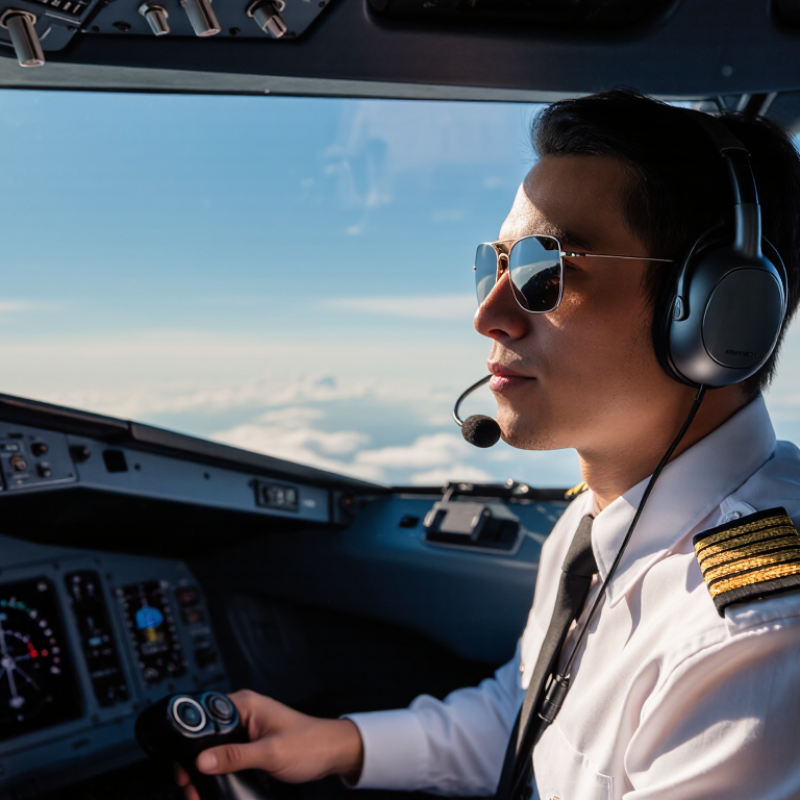
At altitude, sunlight changes before it reaches your eyes. The World Health Organization reports that UV levels rise by about 10% for every 1,000 metres of elevation. That is a general outdoor estimate, not a cabin measurement. Aircraft structure and windows alter exposure, while glare can still feel intense above clouds. Snow, ice, and bright cloud tops can reflect light into the cockpit. That matters.
Regular sunglasses are not automatically unsafe, but “dark” does not mean strong UV protection. Look for verified UVA and UVB blocking, rather than judging by lens tint. A 2015 JAMA Dermatology study measured cockpit windshields and found that UVA transmission varied substantially by glass type; some tested windshields transmitted much more UVA than UVB. The finding concerns flight decks, not every passenger cabin, so it should not be treated as a universal exposure figure. Still, it shows why altitude alone cannot tell you how much protection a pair offers. For pilots, the aircraft’s glazing and operating guidance matter too. Polarized lenses may also make some cockpit displays harder to read. I’d check both the lens specifications and display compatibility; it is an easy detail to overlook.
At high altitude, thinner air filters less ultraviolet radiation before it reaches the aircraft and your eyes. The WHO’s Global Solar UV Index: A Practical Guide estimates UV levels rise about 10% per 1,000 metres of elevation. Snow can reflect up to 80% of UV radiation, according to the guide. Bright cloud tops add glare, too.
Visible light behaves differently from UV. Less atmosphere scatters less sunlight, so direct light can feel harsher above a pale cloud deck. That does not make every ordinary pair unsafe. Verified 100% UVA/UVB or UV400 protection matters more than a very dark tint. Dark lenses without UV protection may let more harmful rays reach the eyes as pupils widen. Fit matters, especially when light enters around the sides.
Tips: Choose close-fitting sunglasses with verified UV protection, and avoid relying on lens darkness alone. Polarized lenses can reduce reflected glare, but may interfere with some cockpit displays. If you operate an aircraft, check display compatibility before flying with them.
At high altitude, thinner atmosphere filters less ultraviolet radiation than it does near sea level. Aircraft windows may block some UV, but protection varies by aircraft and window material. Bright light can also enter from the sides, reflecting off clouds and pale surfaces. Regular sunglasses may leave gaps around the frame, and their lenses may not provide verified UVA and UVB protection. Dark lenses alone are not proof of safety.
The difference matters over long flights. Strong glare can cause eye strain, while prolonged UV exposure can harm the eyes. A pair labeled “UV400” or “100% UVA/UVB protection” offers clearer evidence than lens darkness. Still, that label does not address every need. Wraparound coverage can reduce side exposure, and sturdy frames may be more practical in a cockpit. Polarized lenses can make some displays harder to read, so check compatibility before flying. I used to think any dark pair would do; that assumption was too casual.
Tips: Choose sunglasses with verified full-spectrum UV protection and comfortable side coverage. Test them with your aircraft’s displays before relying on them. Keep a backup pair nearby. Regular sunglasses can be adequate for some flights, but their protection should be confirmed—not guessed.
| Protection factor | What regular sunglasses may lack | What to check for flight | Why it matters |
|---|---|---|---|
| UV protection | Dark lenses do not necessarily block ultraviolet radiation. Lens darkness mainly indicates how much visible light is reduced. | Look for a clear UV400 or 100% UVA/UVB protection claim from a reliable manufacturer. | UV protection depends on the lens material or coating, not how dark the lens looks. |
| Altitude and exposure | Sunglasses chosen for everyday ground-level use may not account for intense daylight, long exposure, or high-altitude conditions. | Choose lenses with verified UV protection and suitable visible-light reduction; consider the route, weather, and time in sunlight. | UV levels generally increase with elevation outdoors, but actual exposure in an aircraft also depends on the glazing and flight conditions. |
| Coverage and fit | Small or flat-front frames can leave gaps around the sides, allowing bright light to reach the eyes. | Prefer a secure fit and broad coverage without obstructing peripheral vision or interfering with headsets. | Side coverage can reduce light entering around the lenses, especially in a bright cockpit or cabin. |
| Aircraft windows | It is unsafe to assume that every aircraft window blocks all UV. Transmission varies with window material and construction. | Use appropriate eye protection when exposed to bright sunlight, and follow aircraft and operator guidance. | Many aircraft windshields reduce UV substantially, but protection can differ between windshields and side windows. |
| Lens darkness | A very dark lens may reduce visible light too much, while a lighter lens can still provide strong UV protection. | Check the lens’s visible light transmission and use a tint appropriate for the task and lighting conditions. | Excessively dark lenses can make it harder to see instruments, displays, or objects in low-light conditions. |
| Lens category | A lens category describes visible-light transmission, not the level of UV protection. | Under the ISO 12312-1 scale, Category 3 transmits about 8–18% of visible light; Category 4 transmits about 3–8% and is not suitable for driving. | The category helps describe tint strength, but it does not replace checking the UV-protection claim or aviation requirements. |
| Polarization and displays | Polarized lenses can reduce reflected glare, but may interact with some cockpit displays or make certain screen details harder to see. | Check compatibility with the aircraft’s displays and windows before use; do not assume polarization is appropriate for every cockpit. | Display readability and situational awareness take priority over glare reduction. |
| Practical choice | A pair described only as “sunglasses” may provide no verifiable information about UV protection, fit, or tint. | Select well-fitting sunglasses with documented UV protection and a task-appropriate tint; follow pilot, operator, and aircraft guidance. | The right choice balances UV protection, glare control, display visibility, and safe operation. |
Note: This table provides general information, not medical or aviation-operational advice. Follow the aircraft flight manual, operator procedures, and applicable aviation guidance.
At high altitude, the atmosphere blocks less ultraviolet radiation, and snow or cloud can reflect bright light toward your eyes. Regular sunglasses may feel dark enough, but darkness alone does not show how much UV they block. It can mislead.
Look for lenses labeled 100% UVA and UVB protection or UV400. A close-fitting frame with side coverage helps reduce light entering around the lenses. This matters when sunlight comes through a side window or reflects off a pale wing. Choose a tint that keeps important colors clear; gray lenses often preserve color better than strongly tinted ones. Comfort matters, too. A lens that distorts edges can make visual checks tiring.
Polarized lenses reduce glare from reflective surfaces, but they are not automatically the best choice in a cockpit. Depending on the displays and windshield, polarization can make screens harder to read or create uneven patterns. Check the aircraft’s guidance and test visibility before relying on them. Impact-resistant lenses are also worth considering, though they do not replace proper eye protection for every flight. A small scratch can become distracting. The right choice depends on the aircraft, route, and conditions, so ask an aviation eye-care professional if you are unsure.
UV levels rise by roughly 10% for each 1,000 m increase in altitude. The bars show an illustrative estimate for ambient UV above open terrain, calculated relative to sea level; actual exposure varies with conditions, and aircraft windows affect the UV that reaches occupants. Choose sunglasses labeled for full UV protection (such as UV400) rather than relying on lens darkness alone. For flight, also consider glare reduction, suitable visible-light transmission, and whether polarized lenses interfere with cockpit displays.
Why Can't I Use Regular Sunglasses for High Altitude Flight?
How to Choose and Wear Aviation-Appropriate Sunglasses
Choosing flight sunglasses is about more than picking a dark tint. The World Health Organization’s Global Solar UV Index guide reports that UV exposure rises by about 10% for every 1,000 metres of altitude. Actual cockpit exposure also depends on glazing and route, so sunglasses are only one part of protection. Look for lenses labeled to block 100% of UVA and UVB, or UV400. A dark lens alone does not confirm UV protection.
Keep the view clear. The FAA’s Pilot’s Handbook of Aeronautical Knowledge cautions that polarized lenses can make some instrument displays difficult to read and may affect views through laminated windshields. Check your displays and outside view with the glasses on, in the aircraft you fly. Neutral gray lenses generally preserve color cues better than strongly tinted lenses. Avoid lenses so dark that cockpit details disappear in cloud or shade.
Fit matters, too. Frames should sit securely with a headset and leave your peripheral vision unobstructed. Try them before flight, not while taxiing. Small details matter. I would not assume that expensive-looking or very dark sunglasses are automatically suitable; the label, fit, and cockpit check tell you more. If discomfort or glare persists, consult an aviation medical professional.
Thinner air filters less ultraviolet radiation. UV exposure may rise about 10% per 1,000 metres. Snow can reflect up to 80%. Bright cloud tops add glare.
No. Lens darkness does not confirm UV blocking. Choose lenses labeled 100% UVA and UVB protection or UV400. This detail is easy to miss.
Choose a secure, close-fitting frame with side coverage. It can reduce light entering beside the lenses. Check that your headset does not shift it.
Not always. Polarization can make some displays harder to read or create uneven patterns. Test them with your aircraft’s screens and windshield before relying on them.
Neutral gray lenses generally preserve color cues better than strongly tinted lenses. Avoid lenses so dark that cockpit details disappear in cloud or shade.
They may, if they provide verified UV protection and fit well. Check the label, side coverage, and cockpit visibility. “Looks dark enough” is not a useful test.
Try them with your headset before flight. Check instrument screens and the outside view while stationary. Not while taxiing.
No. Exposure also depends on glazing, route, clouds, and reflected light. Sunglasses are only one part of protection. I would not assume one pair suits every flight.
At high altitude, the atmosphere is thinner and provides less protection from ultraviolet radiation. Bright sunlight can also reflect off clouds, snow, or other surfaces, increasing glare and eye strain. Why can't I use regular sunglasses for high-altitude flying? Because ordinary sunglasses may vary in how well they block UV rays, and dark lenses alone do not guarantee adequate protection. They may also leave gaps around the eyes, allowing light to enter from the sides.
For high-altitude flight, choose sunglasses that clearly provide full UVA and UVB protection, such as a UV400 rating, and fit securely with good coverage around the eyes. Lens tint should reduce harsh brightness without making the view too dark, and the frame should remain comfortable during extended wear. Polarized lenses can reduce glare, but check that they work well with the aircraft’s displays and instruments. Wear them consistently in bright conditions, and consider a backup pair in case the primary set is lost or damaged.

Aero Apex